Sunday, July 24, 2011

Santa Barbara, CA

This is a really beautiful area on the southern coast of California. It used to be just a regular town, but then it was "discovered," and now movie stars and singers, as well as Arabian shieks, have mansions here.

Santa Barbara boasts one of the historic California missions that the Catholics built up and down the coast:


Naturally, this heavy early Spanish presence means a lot of Spanish architecture:


Being on the coast is always nice:


Especially if you go to UCSB, which sits RIGHT on the ocean:


You can see some interesting things up in the hills, too. Like this Chumash cave painting site. Apparently there are others, but their location is not publicly known, so as to preserve them from vandals.


There's also Knapp's Castle, whose ruin sits on the hills straddling Santa Barbara and Santa Inez. The temperature/climate difference on either side is huge. Santa Barbara has the lovely, moderating ocean climate, while Santa Inez is just hot and deserty.


Typical plants of the hills:

Saturday, July 23, 2011

Charleston, SC

There have been whole books printed full of photos of Charleston, so one tiny blog post isn't going to cover it. But here's a sampling of what you can see there. Suffice it to say that it was one of only three American cities to have a city wall at some point, it figured heavily in both the Revolutionary and Civil Wars, Blackbeard the pirate once held the harbor for three days, demanding medicines for his crew, and a number of its buildings and nearby plantations have come up on a screen near you (Boone Hall was in the miniseries North and South, for example). Enjoy!

Waterfront Park:


Old Exchange and Provost Dungeon, where pirates were kept in the dungeon, and where (at another time), George Washington was entertained at a ball in which he danced with all 200 ladies present:


St. Michael's, where he attended church:


The Citadel:


Magnolia Cemetery, where the last soldiers of the Civil War were interred in 2004:


Sweetgrass baskets, a local craft that has direct ties to west coast Africa:


A church on James Island, complete with live oaks and Spanish moss:


Boone Hall:


Rainbow Row, downtown--used to be warehouses, then in the 1930s some ladies decided to "restore" the area--making this very scenic, and a whole lot nicer than it was originally:


Charleston is famous for its ironwork. Perhaps you have heard of its famous ironworker artist, Philip Simmons? I don't know who did these gates--but they are very typical of the town.


Single houses were built sideways on their lots because for a time, they figured taxes based on your streetside length of your lot. To get around this, people built their houses one room wide:


Obviously, not all residents had economic concerns in mind:


And some were just nice row houses, like in Europe:


If you get the chance to visit (or live in) Charleston, you really should!

Sunday, June 26, 2011

Nauvoo and Carthage, IL

This is also in non-Chicago Illinois, but it deserves its own post. In the 1840s, LDS leader Joseph Smith started a settlement here on the banks of the Mississippi as a haven for LDS church members who had been driven from Missouri at gunpoint. (Yes--the Missouri lawbooks carried a Mormon extermination order until 1973.) The site of Nauvoo was swampy and marshy. They drained it and built a permanent settlement, including many brick homes and also a temple on the hill. The city was second only to Chicago in size. However, in 1846, Joseph Smith and his brother were murdered by a mob and the decision was made to leave for the western US and to find a place where the people could live in peace. The temple was destroyed by a fire and a tornado. In the intervening years, a utopian commune tried to make a go of it there, and some wine growing has been tried as well. The modern town sits slightly off of the historical site and never regained its size and importance once the Mormons left. The LDS (and to a lesser extent, the Reorganized LDS church) have built up the area as a sort of historical park. Also in 2002, the temple was rebuilt and rededicated and is today a functioning temple. It's a beautiful and fascinating place to visit, especially considering that most homebuilding on the frontier (as it was in the 1800s) consisted of rough wooden homes. Possibly the large influx of settlers from Britain in the 1840s influenced some of the building styles?

The temple during a public open house in 2002, and a copy of a "sunstone" from the temple architecture (there are sun, moon, and star designs on it for architectural interest--the glory of God is like the sun):


Old newspaper office:


Possibly Brigham Young's house:


Nauvoo House. Joseph Smith lived here and also ran it as a hotel for people coming out to the "wild west" (that Illinois was at the time) to check out the area:


A bit of living history. You can watch people do handicrafts from yesteryear here.


The jail in nearby Carthage, where Joseph and Hyrum Smith were supposedly being kept to be safe from mobbers. Unfortunately, they broke through. Joseph and Hyrum were both killed, and others in the jail were wounded.


A monument commemorating the brothers stands outside:

Non-Chicago Illinois

Listening to Hollywood or the publishing industry, you'd think the US consisted of Los Angeles, New York, and a bunch of useless flyover country. The term "flyover country" gets under my skin quite a lot. LA and NYC are actually just a small fraction of the US. Millions of Americans live anywhere but. Not every location may be for you, but it's definitely worth getting to know the rest of the country before dismissing it.

Today's sampling is from central Illinois, deep in America's heartland. Illinois is very green and flat. The soil is excellent for farming, and they produce a TON of corn and soybeans.


There are four seasons with extremes--it can get (for short amounts of time) around zero in winter,


yet soar into the 90s (with 90% humidity) in the summers.


It's also in Tornado Alley. The countryside is dotted with small towns and railroad grain elevators, and the only dips in geography occur along river beds. I notice that some people are mountain people (that would be me) and really need mountains or at least hills towering around them, with the occasional chance to be up high and see everything. But other people find mountains claustrophobic, and want wide open skies. Another mountain/western vs. prairie difference is that in the west, there is plenty of public land with trails for hiking and snowmobiling and the like. In Illinois, all the land is privately owned. You may be able to go jogging on the sidewalks in town, but hiking opportunities are...well, maybe take a vacation elsewhere. But the people in Illinois are very nice and well-educated, so if you like small town life with high educational qualities, if you like to catch fireflies and listen to cicadas in the evening, and if gardening is your favorite thing to do outside, this may be a good location for you.


Champaign and Urbana are really two sides of the same town, and together they house the state's flagship university.


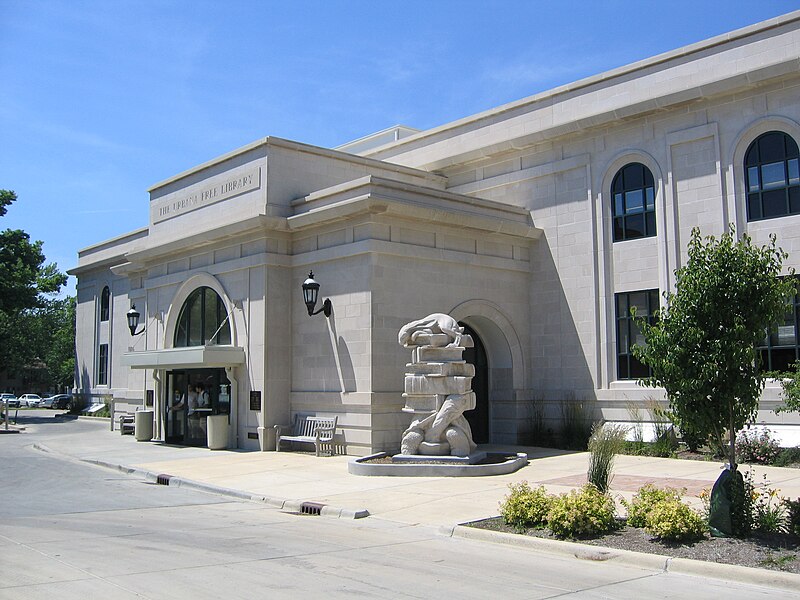
UIUC has the largest library of any public university in the US, with labyrinthine levels deep underground. (This is to keep shade off the state's first experimental corn field in the middle of campus.) To enter the main stacks you have to be a graduate student; undergrads may request material from there and pick it up in the undergrad library. Nonstudents *may* be able to take a guided tour of the stacks, however. Urbana's regular public library (photo here) is ranked in the top 1% in the US as well. And Savoy (which touches the southern end of the town) has an extensive independent bookstore, Pages for All Ages. Consider ALL your reading needs taken care of here! In addition, I've never seen anywhere with as many free pianos listed in the classifieds as here.

UIUC is a large school with many excellently-ranked graduate programs, so it tends to attract a lot of international students, many of whom live in the university's family housing area.


The buildings are not well built (although work requests are addressed immediately). The university rents garden plots to students, and the city of Urbana rents garden plots to residents, so you can see large, beautiful garden plots around town. There's also a good little public bus system. Depending on where you are going, you might be surrounded by people speaking Chinese and Urdu and Spanish and Arabic. It's fun. :)

In nearby Monticello, the university owns an estate and grounds called Allerton Park.


It's quite pretty, and you can check out their web page here.

Illinois towns are the kinds of places where Halloween decorations start a month in advance, where whole neighborhoods go crazy with the Christmas lights, and where the county fair and the summer sweet corn festival are big.


For more (and much better) photos, I recommend taking a look at professional photographer Larry Kanfer's work.